

I have already come across R2-D2 USB hub, which is extremely similar to this one. However, if you’re looking for a slightly less obvious Star Wars accessory, then you might enjoy this one. It’s the R2-Q5 USB Hub. It’s pretty much the same as R2-D2, only it has a slightly darker paint job added to it. Which could make it appeal to those that are tired of all of the bright white gadgets out there. Plus you can only own so many R2-D2 products before you need to branch out to other droids.The R2-Q5 USB Hub
July 16th, 2009 by Ally in PC Gadgets, USB Gadgets
Its All about Sri Lankan Sexy Models

Paid Advertiesment from Google
Other building kits use motors, so what makes OLLO unique? you may be wondering. The difference is how OLLO pieces attach to one another. They attach with an innovative two-part rivet (one goes into the other and presses down to lock the pieces in place). And of course you can always undo the rivets (tool included) to build new and wilder things. The OLLO Action Kit is perfect for getting young minds interested in mechanics and building. OLLO is so much fun to work with, you might just have to buy two: one for the kids…and one for you! Interested? They’ll set you back by $29.99 per set.OLLO - Kids Robotic Action Kit
July 15th, 2009 by Edwin in Childrens Gadgets, Robot Gadgets Could OLLO be the new LEGO? After all, we’re pretty much used to everything being in motion, where static building sets that require this thing called imagination from our kids might actually be out of vogue if the OLLO Action Kit is in vogue. The driving force behind the OLLO action kit is its motor, and it really depends on your imagination on what you are able to churn out.
Why do I want it? Don’t get us wrong, we love mobile phones but why bother wasting your credit and battery calling a mate who is literally round the corner or just out of ear shot. These portable, easy to use, eco friendly gadgets will never leave you with that helpless “out of battery feeling” again. So give the Wind Up Walkie Talkies a go and claim your free talk time.Wind Up Walkie Talkies
 What is it?
This is no “Wind Up”, ha ha (had to get that joke in before anyone else). What you’re looking at is a set of walkie talkies that are powered through the age old art of winding. Like clocks of old, to make these little eco-gadgets work you simply flick out the wind handle, take a firm grip of these Wind Up Walkie Talkies and “wind” like a good-un. The wind to power ratio works out quite nicely: One minute of winding equates to 10 minutes of standby or 2 minutes of talk time and if you wind your way to a full charge it will give you 8 hours of standby or an hour and a half of talk time!
Cant be bothered to wind or just hate the environment? Don’t worry it comes with a 6v mains adapter so you can save your arm for other activities. That’s enough winding chatter, what else does it have to offer? We were genuinely surprised to find out that the range of this two-some was up to 3km and you could choose between 8 different channels to broadcast on. We were also impressed with the rugged design as is also easy to use and as it measure in at a poultry 12.5 x 7 x 4cm, so it’s small enough to slip into most rucksacks.
As far as wind up gadgets go this is by far the best application of the technology we’ve seen. What makes this gadget stand out even more is the multitude of scenario based uses it offers. E.g:
I remember heading into an office job once and the keyboards were awful they had bits of food and dirt on them. Let’s be honest no one wants to work in those sort of conditions and now you can purchase the Washable Keyboard and take your own to work. If you work from home a lot why not just have one for the home office and you can clean it whenever you feel like. Features:Washable Keyboard
 Have you ever taken the time to look at your office keyboard or even your home keyboard? Well have a look now and you will notice how untidy and unclean it is. There has never been anything which you can properly clean your keyboard with. We now have a solution with this great gadget the Washable Keyboard.
Other keyboards I have used normally if you spill drink or water on them they won’t be working for much longer after. This one has no problem with water and your keyboard will be as good as new once you get it washed. The Washable Keyboard is completely waterproof and uses technology known as seal shield. This is so simple just wash and leave to dry and your ready to go again perfect for people who like to rid the office of those germs. You can buy the Washable Keyboard now for a great price of £39.95.
* QWERTY Keyboard layout
* Language Layout United Kingdom
* Dishwasher Safe for easy cleaning
* Protected with Silver Seal™ Antimicrobial properties
* 100% Waterproof
* Natural look and feel with full travel keys
* Laser etched keys will not fade from washing
* Plug n’ Play installation (Gold USB with PS/2 adapter)
* Quick Connect™ feature makes disconnecting a snap!
* Silver washing bowl not included
Specifications:
* Compatibility PC (Vista™, Windows XP™) and Mac (OS X 10.5+)
* Keycaps Type Laser etched
* Life Cycle 10 million strokes
* Power Data Input power: +5v dc 10% low power consumption
* Connector USB Gold, PS/2 adapter included
* Switch Force 55gf 10gf
* Key Elasticity 55/8g
* Total Key Travel 3.0/0.5mm
* Waterproof Capacity 100% waterproof
Seal Shield™ Protects Against:
* Water
* Solvents
* Salt Water
* Disinfectants
* Humidity
* Abrasives
* Dust
* Corrosives
* Dirt
* Sand
* Shock
* Alkaline
* Alcohol
* Bleach
* Acid
* Temperature Extremes
Dimensions:
* Keyboard Size 465mm x 171mm x 33mm

- Scientific American Magazine
Racetrack Memory: The Future Third Dimension of Data Storage
A device that slides magnetic bits back and forth along nanowire "racetracks" could pack data in a three-dimensional microchip and may replace nearly all forms of conventional data storage

- Scientific American Magazine
How to Build Nanotech Motors
Catalytic engines enable tiny swimmers to harness fuel from their environment and overcome the weird physics of the microscopic world

- Features
Angela Belcher: Building Tiny Living Batteries
A mollusk shines light on how to create a viral battery for the 2006 Scientific American 50 research leader of the year

- Scientific American Magazine
The World's Smallest Radio
A single carbon nanotube can function as a radio that detects and plays songs - Scientific American Magazine
News Scan Briefs: Weak on the Nano Risk
Also: Booby Traps for Bacteria and more...

- Scientific American Magazine
Nanomedicine--Revolutionizing the Fight against Cancer
Nanoscale technologies can transform how disease is understood, attacked and possibly prevented

- Scientific American Magazine
A Molecular Checkup: The Nano Future of Medicine
Scientific American Editor in Chief John Rennie introduces the February 2009 issue
We are fascinated every-time a new electronic or product comes out that is smaller, cheaper, and faster than ever. We are fascinated at how technology is advancing and how efficient we can use the resources around us to make life easier. However, even if it appears to be legitimate and based primarily through the advancement of human knowledge, the phrase “It seems too good to be true” never seems to lose its popularity. Nanotechnology is being used every day to develop new electronics and products. However, are we taking a hit to the environment and to our health with the use of these products? Nanotechnology is a branch of science that deals with particles 1-100 nanometers in size. Billions of dollars are being pumped into incorporating nanotechnology. Many experts believe that possible dangers of nanotechnology lie within how these tiny particles may interact with the environment. Many experts say that elements encountered on the nanoscale behave differently than their larger counterparts. Here are some facts about nanotechnology that need some attention to: 1. Nobel-winning physicist Richard Smalley of Rice University discovered that carbon nanotubes and fullerenes, which are nanoparticles of carbon, react differently to the environment. These nanoparticles of carbon behave in ways differently and make their classification a potentially dangerous one. 2. In March 2004, environmental toxicologist Eva Oberdörster, Ph.D. conducted some tests with the Southern Methodist University in Texas. They found that there was extensive brain damage to fish that were exposed to fullerenes for a period of only 48 hours at a relatively moderate dose of 0.5 parts per million. They also experienced gene markups in their livers, which indicates that their entire physiology was affected in the process. In a concurrent test, the fullerene killed water fleas. 3. In 2002, CBEN (Center for Biological and Environmental Nanotechnology) indicated that nanoparticles accumulated in the bodies of lab animals and fullerene could easily travel through soil and be absorbed by earthworms. This is a potential link up in the food chain to humans. 4. In early 2002, the University of California in San Diego revealed that cadmium selenide nanoparticles, also known as quantum dots, may cause cadmium poisoning in humans. 5. In 2004, British scientist Vyvyan Howard published initial findings that had indicated gold nanoparticles might travel through a mother’s placenta to the fetus. 6. In 1997, Oxford scientists discovered that nanoparticles found in sunscreen created free radicals that had damaged DNA. The smaller the particles, the more bio-active, damaging, and toxic they become. This is because their ability to interact with other living systems increases, make it easy for them to cross the skin, lung, and blood/brain barriers. Although we humans have built-in defenses to protect ourselves from natural particles we encounter, nanotechnology is introducing new kinds of particles that some experts say the body might find toxic. Those highest at risk are those employed by the manufacturers to produce products that contain nanoparticles. The National Institute for Occupational Safety and Health (NIOSH) reported that over two-million Americans are exposed to high levels of nanoparticles. They believe that this figure will soon rise to four-million in the near future.

What is Nanotechnology?
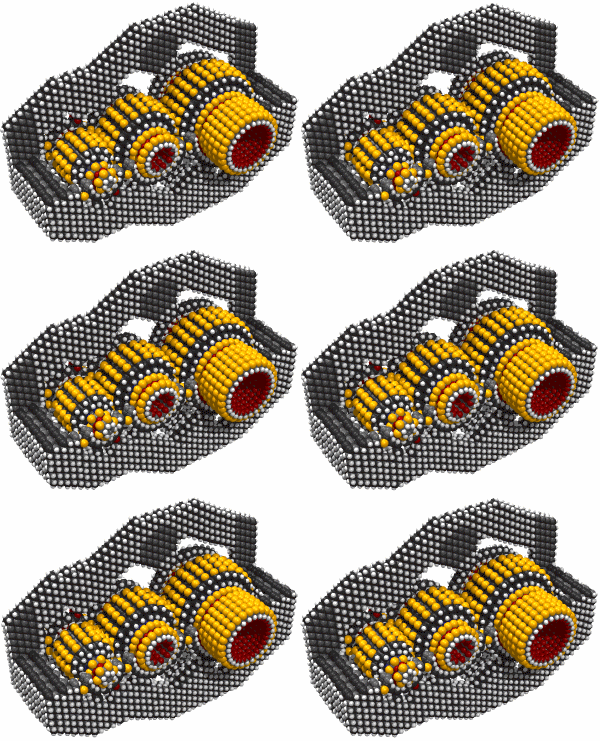
| A basic definition: Nanotechnology is the engineering of functional systems at the molecular scale. This covers both current work and concepts that are more advanced. In its original sense, 'nanotechnology' refers to the projected ability to construct items from the bottom up, using techniques and tools being developed today to make complete, high performance products. | With 15,342 atoms, this parallel-shaft speed reducer gear is one of the largest nanomechanical devices ever modeled in atomic detail. LINK |
 The Meaning of Nanotechnology
When K. Eric Drexler (right) popularized the word 'nanotechnology' in the 1980's, he was talking about building machines on the scale of molecules, a few nanometers wide—motors, robot arms, and even whole computers, far smaller than a cell. Drexler spent the next ten years describing and analyzing these incredible devices, and responding to accusations of science fiction. Meanwhile, mundane technology was developing the ability to build simple structures on a molecular scale. As nanotechnology became an accepted concept, the meaning of the word shifted to encompass the simpler kinds of nanometer-scale technology. The U.S. National Nanotechnology Initiative was created to fund this kind of nanotech: their definition includes anything smaller than 100 nanometers with novel properties.
Much of the work being done today that carries the name 'nanotechnology' is not nanotechnology in the original meaning of the word. Nanotechnology, in its traditional sense, means building things from the bottom up, with atomic precision. This theoretical capability was envisioned as early as 1959 by the renowned physicist Richard Feynman.
I want to build a billion tiny factories, models of each other, which are manufacturing simultaneously. . . The principles of physics, as far as I can see, do not speak against the possibility of maneuvering things atom by atom. It is not an attempt to violate any laws; it is something, in principle, that can be done; but in practice, it has not been done because we are too big. — Richard Feynman, Nobel Prize winner in physics
Based on Feynman's vision of miniature factories using nanomachines to build complex products, advanced nanotechnology (sometimes referred to as molecular manufacturing) will make use of positionally-controlled mechanochemistry guided by molecular machine systems. Formulating a roadmap for development of this kind of nanotechnology is now an objective of a broadly based technology roadmap project led by Battelle (the manager of several U.S. National Laboratories) and the Foresight Nanotech Institute.
Shortly after this envisioned molecular machinery is created, it will result in a manufacturing revolution, probably causing severe disruption. It also has serious economic, social, environmental, and military implications.
Four Generations
Mihail (Mike) Roco of the U.S. National Nanotechnology Initiative has described four generations of nanotechnology development (see chart below). The current era, as Roco depicts it, is that of passive nanostructures, materials designed to perform one task. The second phase, which we are just entering, introduces active nanostructures for multitasking; for example, actuators, drug delivery devices, and sensors. The third generation is expected to begin emerging around 2010 and will feature nanosystems with thousands of interacting components. A few years after that, the first integrated nanosystems, functioning (according to Roco) much like a mammalian cell with hierarchical systems within systems, are expected to be developed.

Some experts may still insist that nanotechnology can refer to measurement or visualization at the scale of 1-100 nanometers, but a consensus seems to be forming around the idea (put forward by the NNI's Mike Roco) that control and restructuring of matter at the nanoscale is a necessary element. CRN's definition is a bit more precise than that, but as work progresses through the four generations of nanotechnology leading up to molecular nanosystems, which will include molecular manufacturing, we think it will become increasingly obvious that "engineering of functional systems at the molecular scale" is what nanotech is really all about.
Conflicting Definitions
Unfortunately, conflicting definitions of nanotechnology and blurry distinctions between significantly different fields have complicated the effort to understand the differences and develop sensible, effective policy.
The risks of today's nanoscale technologies (nanoparticle toxicity, etc.) cannot be treated the same as the risks of longer-term molecular manufacturing (economic disruption, unstable arms race, etc.). It is a mistake to put them together in one basket for policy consideration—each is important to address, but they offer different problems and will require different solutions. As used today, the term nanotechnology usually refers to a broad collection of mostly disconnected fields. Essentially, anything sufficiently small and interesting can be called nanotechnology. Much of it is harmless. For the rest, much of the harm is of familiar and limited quality. But as we will see, molecular manufacturing will bring unfamiliar risks and new classes of problems.
General-Purpose Technology
Nanotechnology is sometimes referred to as a general-purpose technology. That's because in its advanced form it will have significant impact on almost all industries and all areas of society. It will offer better built, longer lasting, cleaner, safer, and smarter products for the home, for communications, for medicine, for transportation, for agriculture, and for industry in general.
Imagine a medical device that travels through the human body to seek out and destroy small clusters of cancerous cells before they can spread. Or a box no larger than a sugar cube that contains the entire contents of the Library of Congress. Or materials much lighter than steel that possess ten times as much strength. — U.S. National Science Foundation
Like electricity or computers before it, nanotech will offer greatly improved efficiency in almost every facet of life. But as a general-purpose technology, it will be dual-use, meaning it will have many commercial uses and it also will have many military uses—making far more powerful weapons and tools of surveillance. Thus it represents not only wonderful benefits for humanity, but also grave risks.
A key understanding of nanotechnology is that it offers not just better products, but a vastly improved manufacturing process. A computer can make copies of data files—essentially as many copies as you want at little or no cost. It may be only a matter of time until the building of products becomes as cheap as the copying of files. That's the real meaning of nanotechnology, and why it is sometimes seen as "the next industrial revolution."
My own judgment is that the nanotechnology revolution has the potential to change America on a scale equal to, if not greater than, the computer revolution. — U.S. Senator Ron Wyden (D-Ore.)
The power of nanotechnology can be encapsulated in an apparently simple device called a personal nanofactory that may sit on your countertop or desktop. Packed with miniature chemical processors, computing, and robotics, it will produce a wide-range of items quickly, cleanly, and inexpensively, building products directly from blueprints.
 ◄ Click to enlarge
Artist's Conception of a Personal Nanofactory
Courtesy of John Burch, Lizard Fire Studios (3D Animation, Game Development)
Exponential Proliferation
Nanotechnology not only will allow making many high-quality products at very low cost, but it will allow making new nanofactories at the same low cost and at the same rapid speed. This unique (outside of biology, that is) ability to reproduce its own means of production is why nanotech is said to be an exponential technology. It represents a manufacturing system that will be able to make more manufacturing systems—factories that can build factories—rapidly, cheaply, and cleanly. The means of production will be able to reproduce exponentially, so in just a few weeks a few nanofactories conceivably could become billions. It is a revolutionary, transformative, powerful, and potentially very dangerous—or beneficial—technology.
How soon will all this come about? Conservative estimates usually say 20 to 30 years from now, or even much later than that. However, CRN is concerned that it may occur sooner, quite possibly within the next decade. This is because of the rapid progress being made in enabling technologies, such as optics, nanolithography, mechanochemistry and 3D prototyping. If it does arrive that soon, we may not be adequately prepared, and the consequences could be severe.
We believe it's not too early to begin asking some tough questions and facing the issues:
 | Who will own the technology? |
| Will it be heavily restricted, or widely available? |
| What will it do to the gap between rich and poor? |
| How can dangerous weapons be controlled, and perilous arms races be prevented? |
Many of these questions were first raised over a decade ago, and have not yet been answered. If the questions are not answered with deliberation, answers will evolve independently and will take us by surprise; the surprise is likely to be unpleasant.
It is difficult to say for sure how soon this technology will mature, partly because it's possible (especially in countries that do not have open societies) that clandestine military or industrial development programs have been going on for years without our knowledge.
We cannot say with certainty that full-scale nanotechnology will not be developed with the next ten years, or even five years. It may take longer than that, but prudence—and possibly our survival—demands that we prepare now for the earliest plausible development scenario.


